

A lead generation Australia program should verify every contact against four criteria before a name reaches sales. According to HubSpot research, loose qualification wastes 21 per cent of a rep’s week on dead names.
A qualified lead in Australia is a verified prospect that has passed need, budget, timeline, and compliance checks before anyone from sales picks up the phone. Without all four checks, you have a name and a number.
Most Australian businesses waste pipeline hours on names because providers optimise for volume. This guide walks you through the BANT+C framework, the three patterns that signal a low-quality provider, and a practical audit.
Key Takeaways
- A sales-ready prospect is verified against need, budget, timeline, and compliance, not a contact who simply stayed on the line for 30 seconds.
- The classic framework still works but needs Australian-specific additions: Privacy Act consent capture and register screening.
- Most providers ship names that are really curious browsers. Always ask to see the qualification script in writing before you sign.
- Regulated industries such as health insurance and aged care require tighter checks because unqualified conversations cost more.
- A well-screened prospect should cut your sales team’s talk-to-close time by 40 to 60 per cent compared with self-sourced cold calls.
What Really Counts as a Sales-Ready Prospect in Australia?
A lead is qualified when a sales rep can open the conversation and immediately move toward value, not spend fifteen minutes re-asking questions. In a B2B outbound context, that means four pieces of verified data sit in the call notes before handover.
Need That Is Clearly Verified Rather Than Politely Assumed
The prospect has described a specific problem your product solves, in their own words, to the agent. Not “interested in learning more” but concrete pain like “we are losing customers after hours and cannot roster evening cover across the team”.
Budget That Is Openly Discussed Rather Than Quietly Guessed
Either the prospect has confirmed a realistic budget range, or they have confirmed they influence budget decisions inside their own company. If neither is true on the call record, you have a conversation on your hands, not a real lead.
A Clear Decision Timeline Inside Your Current Sales Cycle
The prospect has said when they expect to decide on a provider. “Within the next quarter” is workable for most teams. “Eventually” is simply not a timeline and does not belong inside a forecasted pipeline today at all.
Full Compliance Capture That Is Clean and Fully Documented
The prospect has given explicit consent to be contacted, the number is screened against the Do Not Call Register, and the call is being recorded in line with privacy obligations. Compliance is never optional on any live Australian campaign.
The lead generation Australia process at Health Connect Group runs every prospect through all four checks before a name is handed to the client’s sales team for follow up on the account in any campaign.
The BANT+C Qualified Prospect Framework That Works in 2026
The classic four-letter qualification model has been the default B2B approach for decades. It still works in 2026. For the Australian market it needs a fifth check: Compliance. Every serious program should use BANT+C on every call made this year.
Step 1: Budget Availability Inside the Prospect Company
Does the prospect have spending available or accessible for this type of purchase? You are not asking for an exact figure here. You are verifying there is a real spending pool and you sit inside the price range they already operate in each quarter.
Step 2: Authority or Influence Over the Buying Decision
Is this person the decision-maker, a key influencer, or someone who can pass the conversation directly to one? According to McKinsey research, around 77 per cent of B2B buyers now describe their last purchase as complex, per McKinsey.
Step 3: A Clearly Articulated Need the Prospect Owns
Listen. What specific problem are they trying to solve in the next six months? According to Salesforce State of Sales, reps who document the buyer pain close 28 per cent faster, per Salesforce research today.
Step 4: A Realistic Timeline You Can Forecast Against
When are they planning to make a final decision on a provider? “No idea” usually means the rep will chase this prospect for six months with no close. A clearly defined timeline lets you forecast pipeline and prioritise active accounts weekly.
Step 5: Full Compliance Capture for Every Single Call
Has explicit consent been captured on the recording? Is the contact screened against the register? Is the call recorded in line with Australian privacy obligations? A name that passes BANT but fails compliance is a risk you cannot accept.The Office of the Australian Information Commissioner publishes the Australian Privacy Principles. According to OAIC guidance, every outsourced program must operate inside these principles, not around them, on every dial made each week.
Want qualified names, not just more contacts on a list?
Our Australian agents qualify every prospect against your exact criteria before handover. Book a free 30-minute discovery call and we’ll map the BANT+C framework to your own sales process and CRM today.
Why Most Providers Ship Unqualified Australian B2B Leads
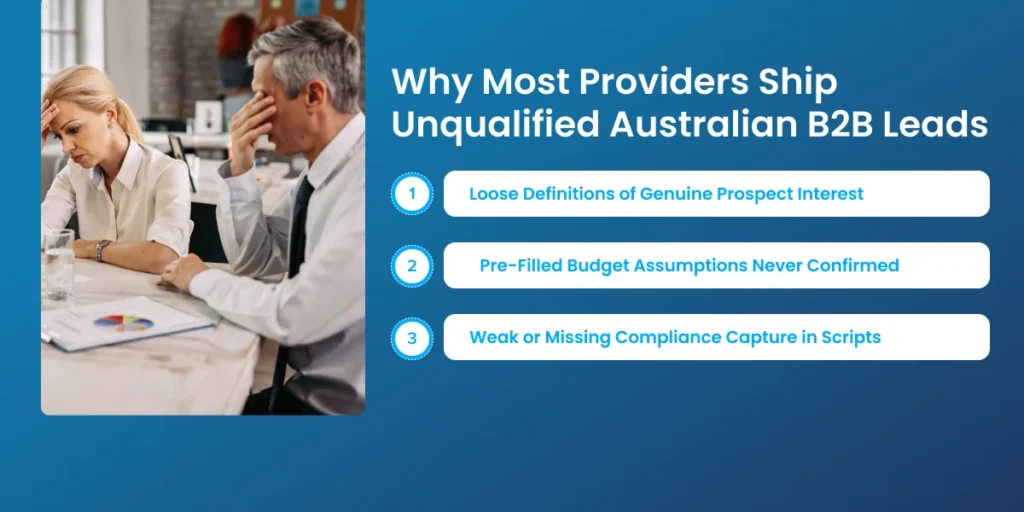
The commercial incentive for most b2b lead generation Australia providers is volume. They are paid per name delivered, so the fastest path to margin is relaxing the qualification bar and shipping many records each week. You carry the sort cost.
The volume-first pattern shows up in three consistent provider behaviours across the market. Each one is visible inside the first week of the contract if you know exactly what to watch for on the daily call summary reports:
Pattern 1: Loose Definitions of Genuine Prospect Interest
A “qualified” name quietly becomes anyone who stayed on the call thirty seconds, agreed to receive more information, or confirmed a job title held by a suitable buyer. None of those signals verify real need, active budget, or a decision timeline.
Pattern 2: Pre-Filled Budget Assumptions Never Confirmed
The provider infers budget from company size or sector rather than directly asking the person during the call. Two businesses of the same size and sector can have wildly different spending authority and different active budget cycles across the year.
Pattern 3: Weak or Missing Compliance Capture in Scripts
Consent language is rushed, register screening happens once at list-build and not again at call time, and call recording is inconsistent across the team’s shifts. You assume the provider has it covered. Sometimes they do not.
| Practice | Volume Provider | Rigorous Provider |
|---|---|---|
| Lead definition | 30 second call | BANT+C verified |
| Budget check | Inferred from size | Confirmed live |
| Authority check | Job title only | Influence verified |
| Timeline | Not captured | Quarter defined |
| DNCR screening | List build only | Every call cycle |
| Consent capture | Implied | Explicitly recorded |
| Handover notes | Contact details | Full call notes |
| Price model | Per name volume | Per qualified name |
“Australian sales teams waste a significant share of their working week on names that were never truly qualified, and the root cause is nearly always an agency paid on raw volume rather than performance a client can actually forecast and bank each month.”
– Matthew Michalewicz, Chief Executive Officer, Complexica
Read More About: How Much Does an Outsourced Call Centre Cost?
How Does Qualification Change Inside Regulated Industries?
Health insurance, aged care, financial services, and energy retail all carry stricter demands because the cost of an unqualified conversation is higher. Our Australian call centre agents train for months on sector compliance before a first dial.
Health Insurance Qualification Standards in Australia Now
The prospect’s current insurer, product tier, and renewal date are part of proper qualification on the first call. Without them, the sales conversation stalls on basic facts the agent should already have recorded in the handover note.
Aged Care Qualification Criteria That Respect the Family
Be gentle. Qualification must capture the enquirer’s relationship to the care recipient, urgency of placement, and funding status. Skipping any creates a painful follow-up for a family already under significant stress.
Financial Services Regulatory Qualification Requirements
Product type, current provider, regulatory status of the advice requested, and full disclosure obligations all sit inside proper qualification. Generic “financial services names” from a provider without real sector fluency are regulatory time bombs.
Energy Retail Qualification Criteria for Churn Campaigns
Current retailer, contract end date, tariff structure, and meter type together decide whether a call is worth having at all. Without those four data points, churn outbound campaign activity hits hard walls and conversion rate drops.
In every regulated case, a serious team needs product training before it picks up the phone for the first dial. Industry specialisation is not optional. It is the difference between a conversation that moves forward and one that wastes the day.
How to Build Your Own Prospect Qualification Criteria Today
Generic criteria are a solid starting point for a new program. The best lead qualification rules are specific to your product, sales cycle, and target customer profile in Australia today. Here is how to build yours in six practical steps.
Step 1: List Your Best Five Customers From the Last Year
Write down five of your highest-value, fastest-closing customers from the last twelve months. These become your qualification template. The patterns they share define what a genuinely good prospect looks like for your sales team in 2026.
Step 2: Extract Their Clear Common Traits
What do they actually share in company size, industry, role title of the primary buyer, pain point, budget range, and decision timeline? The pattern across five live cases is usually enough to define a clean usable profile for the team to use.
Step 3: Clearly Define Your Disqualifiers Upfront
Just as important: what makes a prospect wrong for you? Wrong sector, wrong company size, wrong decision timeline, wrong geographic region. Disqualifiers save more sales time than the positive qualifiers ever manage to deliver.
Step 4: Draft a Practical Qualification Script
Turn the criteria into six to ten clear questions the agent asks during the first call. Each question ties back directly to one of the five qualification categories. Miss three or more answers? Not a lead yet.
Step 5: Agree the Handover Format With Sales
What does the sales team actually need to see when a name lands in the CRM? Typically: full contact details, verified criteria, complete call notes, and the recommended next action (book meeting, send proposal, or continue to nurture further).
Step 6: Review Monthly and Refine the Criteria
Every month, review which qualified names closed and which stalled. Look for patterns. Drop-offs at the first sales conversation reveal exactly which criteria inside the script need tightening for the coming month’s calls.
Read More About: How Do SMEs Stop Silent Customer Churn in 2026?
Does Qualification Differ Between Inbound and Outbound?
The qualification bar should be the same regardless of where the name originated in your funnel. What changes is the sequence. Inbound and outbound start from different points, but the end state of a clean documented record should look identical.
Inbound Qualification in a Live Australian Market Context
The prospect has self-identified need by reaching out through a form, phone, or referral. Qualification then focuses on confirming budget, authority, timeline, and product fit. Compliance sits in the consent capture at the start of the call.
Outbound Qualification for Every Single Campaign Launch
You are interrupting someone’s day with a cold dial. The first job is to earn the right to ask questions by clearly stating who you are, why you are calling, and the register position. Then you move into need, budget, authority, and timeline.
End state standard: A verified prospect passed to sales with the same criteria regardless of whether the record originated inbound or from an outbound dial. Any program that treats them differently leaves real quality on the table.
How Do You Audit a Lead Generation Provider Before Signing?
Before signing any b2b lead generation Australia contract, walk the provider through the audit below together. A provider serious about quality will welcome the questions. One who stalls on the detail is quietly showing you how the contract will go.
Ask to See the Full Live Qualification Call Script Upfront
The script should have explicit criteria questions, compliance disclosures, and consent capture language already written in. If the provider cannot share it before you sign, or the version is obviously generic, you have your answer on quality.
Listen Carefully to Three Recent Anonymised Call Recordings
Request three anonymised recordings of qualified names they recently shipped to a current client. Listen to whether the agent actually verified need, budget, authority, and timeline live, or simply collected contact details and moved on quickly.
Check the Register Screening Process for Every Call Cycle
Ask when register screening actually happens: at list build, before each call cycle, or at the point of dial. The correct answer is “before each call cycle, every cycle”. Anything less frequent is a real compliance risk sitting in each batch.
Confirm Per-Lead Definitions Live in the Signed Writing
Get the exact definition of a qualified name into the signed contract in writing before anything else. If the provider refuses, walk away. Vague definitions are precisely how unqualified names get billed as qualified month after month.
Request the Complete Handover Format in Advance of Signing
What will your sales team actually receive when a name lands in the CRM? Contact details alone are not enough for a serious team. Full call notes, verified criteria, and a recommended next action are the minimum for an appointment setting program.
Check Live Industry Experience Numbers on the Account Daily
For regulated sectors, ask how many agents on your account have prior hands-on experience in your industry. If the honest answer is “we train them from zero”, clarify how long the training takes, who signs off, and how exceptions are escalated.
Ready to see what a properly screened prospect actually looks like?
Our Australian lead generation team runs full criteria checks on every prospect before handover. Get an itemised quote back in 48 hours with no lock-in and no offshore handoff on any inbound campaign.
Conclusion
Getting qualification right across a 2026 sales pipeline comes down to three non-negotiable steps: a documented script, written definitions in the contract, and a provider that treats compliance as the first check rather than the last.
At Health Connect Group, we qualify every prospect against a client-specific script before any name reaches sales, with register screening on every call cycle and full consent on every single dial across every campaign running this year.Visit Health Connect Group or contact us for a clear itemised quote back within 48 hours of discovery, with capped cost per acquisition pricing, no lock-in, no offshore handoff, and a dedicated account manager from day one.