

Proactive client services teams across Australia save 40 to 70 per cent of at-risk accounts by acting on customer behaviour signals before the renewal decision is made within the business.
Most customers never complain before they leave. They simply stop renewing, stop responding, or quietly move to a competitor after a private decision made weeks earlier at home or inside their own office.
By the time churn shows up in the monthly dashboard, the conversation that could have saved the relationship has already passed. According to McKinsey & Company, active retention spend returns five to seven times the rate of fresh acquisition spend.
This guide walks through the behaviour signals that predict churn, the call structure that saves accounts, and the 30-day build that lets a small Australian team stand up a retention program without a six-figure consultancy bill.
Key Takeaways
- Most customers who leave Australian businesses never complain first. Silent churn is the default behaviour, not the exception.
- Behaviour signals (usage drop, payment delays, support silence) predict churn earlier than any survey score or post-call rating.
- A proactive retention call at the right moment saves 40-70% of at-risk accounts across most Australian industries.
- Retention calling is regulated. Privacy Act 1988 disclosures and Do Not Call Register obligations apply from the first call onward.
- A focused 30-day build gets a working retention program live without a year of planning, a six-figure consultancy bill, or a hiring cycle that delays the launch by another full quarter.
Why Australian Customers Leave Without Complaining First
Unhappy Australian customers rarely complain before they leave. A proactive client services Australia program treats silence as a risk signal, not a safety signal, and responds accordingly across every flagged account.
when a customer ends the relationship without raising the issues that drove their decision, leaving the business no chance to respond, resolve the friction, or retain the account before the contract ends.
Three behaviour patterns reinforce silent churn inside Australian B2B and consumer relationships. Recognising them helps customer success teams shift from reactive ticket work to proactive retention calling across a defined watchlist.
The Renewal Decision Actually Happens Privately Weeks Ahead
Most contract renewals are decided 60 to 120 days before the stated expiry date. By the time the formal renewal email lands in the buyer’s inbox, the decision has already been made and quietly communicated inside the customer’s leadership team.
The private decision window is where retention actually lives. A conversation at week 90 can change a renewal outcome. The same conversation at week 2 is just a polite reason for the customer to confirm their procurement decision already made.
Small Problems Quietly Accumulate Across the Whole Quarter
No single issue triggers a complaint. A slow response here, a billing error there, a missed follow-up last month. Individually, none of them rise to the level of a phone call, and most Australian customers find lodging a formal complaint awkward.
Together, those small frustrations become a quiet decision to test the market. The customer does not announce it. They take a competitor call they would have refused six months earlier, and the account trajectory shifts without notice.
Credible Alternatives Are Genuinely One Quick Search Away
For most Australian B2B and consumer categories, credible alternatives are easy to find and easier to contact than they were five years ago. The friction of switching has dropped as integrations and data portability have improved across the market.
Loyalty must be earned every quarter, not assumed after the first contract. According to Australian Competition and Consumer Commission, switching costs have declined materially across telecoms, energy, and finance in the past five years.
The Real Cost of Silent Churn for Australian Businesses
Silent churn costs more than loud churn because the provider never gets the chance to save the relationship. The true cost lands across four budget lines that rarely surface in the standard monthly churn dashboard reviewed in leadership meetings.
A customer expected to renew for three more years leaves with all of that revenue. Replacement acquisition typically costs five to seven times the retention cost across most Australian service categories and subscription models.
Acquisition spend is amortised across the customer lifetime value of the account. A high churn rate pushes your cost per acquisition up and your payback period out, which squeezes the marketing budget in the quarter you need it to fund growth.
According to Australian Bureau of Statistics, SMEs drive the majority of private-sector employment nationally. Most of these firms cannot absorb a churn spike with reserve cash flow or a fast replacement campaign in the market.
Customer retention Australia teams rarely see the customers they lose in the dashboard. Without the feedback loop, the same issues keep repeating, and the warm referral pipeline dries up months before the churn number moves on the board.
Are your customers leaving without telling you why?
Our proactive retention calls catch at-risk accounts before the renewal decision is actually made. Book a free 30-minute discovery call to see exactly how it would work for your Australian book of business.
The At-Risk Customer Signals Every Retention Team Monitors
Behaviour data predicts churn earlier than any Net Promoter Score or first call resolution rating in most Australian B2B contexts. The signals cluster into four categories, and a ranked watchlist is built by counting how many flag on each account.
Engagement Signals That Predict a Quiet Departure Decision
Engagement signals are the earliest warning that an account is drifting. They appear 60 to 120 days before the renewal decision is formally made, which makes them the most valuable category for retention teams to watch:
- Login or usage frequency has dropped noticeably in the last 30 to 60 days
- Support ticket volume has gone to zero (usually disengagement, not satisfaction)
- Newsletter or account update open rates have fallen off a previous baseline
- Scheduled check-in calls have been missed or rescheduled more than twice
- Training session attendance from the customer’s side has dropped sharply
Financial Signals That Reliably Predict an Upcoming Churn
Financial signals confirm a decision that engagement signals first hinted at. Once they appear, the retention window shortens quickly, and the call needs to happen inside days rather than weeks to have a realistic chance of changing the outcome:
- Payment delays, even by a few days, on an account previously on time
- Downgrade to a smaller plan or a reduced number of active user seats
- Removal of the auto-renewal flag inside the billing system on file
- Credit card expiry without an updated card promptly added to the system
Relationship Signals From Your Main Customer Contact Points
Relationship signals are softer but just as predictive once they cluster on one account. The loss of a friendly internal champion often precedes a formal review of your contract by a new leadership team without the historical context:
- The main contact has changed role, left the company, or gone quiet
- A key stakeholder has stopped responding to email threads you initiated
- A recent complaint (however small) was escalated internally on their side
- A competitor brand name is dropped casually in an unrelated conversation
Product Signals That Reveal Real Unresolved Account Friction
Product signals reveal live friction that the customer has not formally raised with your support team. They often sit behind the decision to test a competitor, because the customer no longer trusts that the issue will be resolved on your roadmap:
- A specific feature they rely on has broken or been quietly deprecated
- A recent bug or service interruption sat unresolved longer than usual
- The customer has requested a feature twice with no visible product response
- Documented workarounds have become part of their standard operating process
Three or more live signals on a single account is a clear prompt for a proactive retention call this week, not next quarter’s standard check-in cadence that only captures the accounts that have already decided to leave.
The Proactive Retention Playbook That Actually Works Today
The playbook that works is not complicated at all. It is a sequence of decisions made repeatedly, in the right order, with the right tone, and documented consistently so the team can improve call quality across each review cycle over time.
Trigger the Retention Call on a Live Signal, Not a Calendar
Calling every customer quarterly is better than not calling at all, but not by much in practice. Calls triggered by an actual at-risk signal carry far more weight and land at the precise moment they genuinely matter to the account.
A calendar call arrives at random. A signal call arrives when the customer has just felt the friction, and the conversation meets them in the state of mind where they are most open to being heard. The timing alone lifts the save rate meaningfully.
Open the Retention Call With Curiosity, Not a Sales Pitch
The first 90 seconds of the call matter most to the entire conversation. Start with an open question about how the last 30 days have been at their end, not a sales line. The customer should feel genuinely asked, not sold to.
A well-trained account manager leads with curiosity and waits for the answer. The silence that follows an open question is where the real reason for the at-risk signal surfaces, which is where the retention conversation makes progress.
Name the Signal Carefully and Only When Clearly Appropriate
If the signal is factual and unambiguous, it is often fine to name it directly. “I noticed you have not logged in much this month, just wanted to check everything is working smoothly” is a clean open that most customers receive well.
Avoid naming signals that might feel like surveillance. A late payment, a support ticket pattern, or a contact change each need careful framing. Name the facts the customer expects you to see, and handle softer signals through open questions instead.
Listen Far More Than You Talk During the Discovery Phase
The retention agent’s primary job is to find the real reason behind the signal. Most customers will not lead with it in the first sentence. The second or third follow-up question usually gets closer to the truth than the first one does.
Agents trained for retention listen three or four times what they speak. The temptation to defend the product, argue the invoice, or offer a discount too early is the single most common reason retention calls fail to save the account.
Resolve Inside the Call or Escalate With a Clear Timeline
Where possible, fix the issue inside the live call or commit to a specific timeline on the spot. If it needs escalation, get the customer on a call with the right person inside 48 hours, not a ticket that vanishes into the support queue.
Speed matters. Rapid complaint resolution and after-hours support reduce customer churn more reliably than any pricing discount offered late. The retention call is the right moment to show visible movement.
Document Every Retention Call and Feed the Data Back In
Every retention call produces notes, a risk rating, and a recommended next action. Those notes feed the product, customer success, and exec teams so repeating issues surface in planning rather than disappearing into an archive.
Patterns drive decisions. Thirty calls where the same feature gap appears is a product priority, not a service issue. Without the feedback loop, each retention call fixes one account while the same issue costs you three more elsewhere.
Read More About: What Makes a Qualified Lead in B2B Sales 2026?
How Does a Proactive Retention Call Actually Unfold Live?
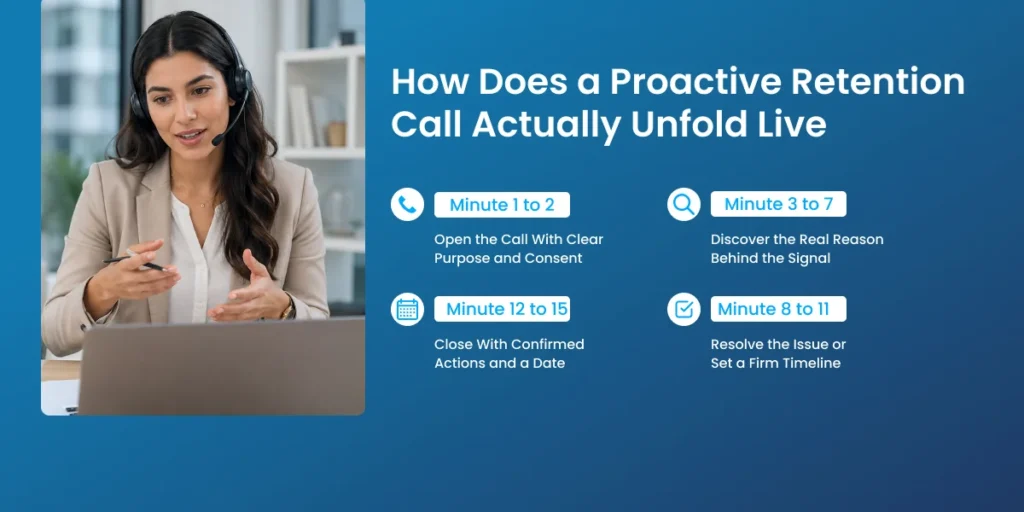
A retention call is shorter than most people expect before they hear one. The structure that works consistently runs between 8 and 15 minutes, across four clean phases that each serve a specific purpose in the conversation.
Minute 1 to 2: Open the Call With Clear Purpose and Consent
Clear introduction, stated purpose of the call, acknowledgement of the customer’s time. No sales framing in the first minute. Do Not Call obligations do not apply to existing-customer calls with consent, but Privacy Act disclosures still apply.
Minute 3 to 7: Discover the Real Reason Behind the Signal
Open questions about their last month, their experience, what has worked, and what has not. The agent’s job is to listen and probe gently, not to present solutions or defend the product before the real issue has surfaced.
Minute 8 to 11: Resolve the Issue or Set a Firm Timeline
Restate the issue in the agent’s own words to confirm shared understanding. Offer an action, a fix, or an escalation with a clear timeline attached. Get explicit agreement from the customer on the next step before moving into the close of the call.
Minute 12 to 15: Close With Confirmed Actions and a Date
Confirm the action items agreed, the timeline committed, and the date of the next check-in. Thank the customer genuinely. Note the call outcome, risk rating, and recommended action in the system before moving to the next call on the list.
A dedicated Australian customer support team handling retention at volume can run 20 to 35 of these calls per agent per day, with detailed notes on each one, feeding a weekly pattern review that tightens both the script and the list criteria.
Reactive Versus Proactive Retention: Which Strategy Wins?
Most customer service teams operate reactively by default. The customer contacts them first, and the team responds to whatever has already escalated. Effective retention requires the opposite posture across the whole team’s working week.
| Dimension | Reactive Retention | Proactive Retention |
|---|---|---|
| Trigger point | Complaint or cancellation request | Behaviour signal flagged by data |
| Timing of contact | After the problem has escalated | Before the customer has decided |
| Typical save rate | 10 to 25 per cent of flagged | 40 to 70 per cent of flagged |
| Call cost | Higher (discounts, escalations) | Lower (structured conversation) |
| Intelligence yield | One customer at a time | Patterns feed product and service |
| Relationship impact | Transactional repair | Trust-building investment |
| Team posture | Defensive and explanatory | Curious and exploratory |
| Data requirement | Ticket system only | Usage, billing, support, CRM |
The difference is not mystical. Reactive retention fights for the customer after the internal decision is made. Proactive retention invests in the relationship before that decision, which is a far easier conversation to win.
How to Build a Retention Calling Program Inside 30 Days
A working retention program does not need 12 months of planning or a six-figure consultancy build. It needs 30 days of focused execution, a small team, and clear weekly review cadence that improves the script and the watchlist continuously.
Step 1: Pull the Last 12 Months of Churn Data
Identify who left, when they left, and why if the reason is actually known or recorded. Look for patterns by customer segment, industry, account tenure, and account size to see where retention effort will pay back the fastest in your book.
Step 2: Define the Specific Signals That Matter
From the churn pattern review completed in step one, pick the three to five behaviour signals that most often precede churn in your data. These become the watchlist criteria that will trigger a retention call inside the operating cadence.
Step 3: Build the Watchlist Data Feed and Review Cadence
Usage, billing, support, and CRM data need to feed into a single view the retention team works from each morning. A weekly updated sheet is enough to start. A live dashboard can come later once steady state is reached.
Step 4: Draft the Call Script for Each Signal Pattern
Open, discover, resolve, close. Around 10 to 12 script branches cover most common signal combinations seen in the first quarter of operation. Review the script with legal to confirm Privacy Act compliance at all consent points.
Step 5: Train Two Agents on the Full Script
Start with two agents, not ten. Small volume, tight feedback loop, high visibility. Measure save rate and average call length from day one so the script and the criteria can be tuned quickly across the first two weeks of live calling work.
Step 6: Review Call Outcomes Weekly for the First Month
Every Friday, review the week’s calls: save rate achieved, common issues raised, escalations made, and script refinements needed. Adjust weekly during the build phase, not quarterly once the program has reached steady state.
Step 7: Scale the Team Once the Save Rate Is Stable
Once the save rate on flagged accounts stabilises above 35 per cent, expand the team and widen the watchlist criteria to capture a broader segment of the at-risk book without diluting the call quality or save rate already achieved.
Steady state typically arrives around week 8 to 10. Most programs that invest in a focused retention function see the save rate stabilise within the first two months of live operation as call data accumulates each week.
Read More About: How Much Does an Outsourced Call Centre Cost?
Ready to build a proactive retention program?
Our trained Australian agents can have a retention calling program live on your book within 5 business days of the discovery call. Month-to-month terms, Privacy Act compliant, named point of contact from day one.
Conclusion
A working client services Australia retention program rests on three foundations: behaviour signals feeding a live watchlist, a consistent call structure trained into the team, and a weekly review that tightens the script each month.
At Health Connect Group, we deliver 100 per cent Australian agents, month-to-month terms, and full Privacy Act compliance across every single retention engagement we run for businesses Sunshine Coast.Visit Health Connect Group or contact us for a clear itemised proposal within 48 hours of the discovery call, with no 12-month lock-in, no offshore handoff, and capped billing on every engagement we run.